I am a multidisciplinary artist from Bangalore, studied in MS University. Currently practicing in Bangalore, Karnaraka. My work has developed in number of ways over the years yet from the very beginning of my art practice, I have workded in Painting, Printmaking, Installation, Video Art and Live/ Performance art. My intention is to blend these mediums into an interdisciplinary language.
Showing posts with label Live Performance Dimple B Shah. Show all posts

Wednesday, December 23, 2020

Outside Frame -Natak Company


Lock Unlock Performance Art Project 11 


22. December 2020

Concept Note by Dagmar I. Glausnitzer-Smith

Glimpses behind Isolation
Visual material is assembled, collaged and controlled in these days of presentations via the virtual channels. The preparations regress to an intense aesthetic and composed image production. 
How can this be interrupted and directed towards another perspective, revealing details of ‘Self’ in the intimate sphere, which in any way stays hidden to the unrecognizable (zoom)spectator. Details, materials and objects which may have been captured before in physical, public space, now have been edited away from the site of Performance Activity.
How does the artist’s expectation level, these days influence the operating virtual eye?
Extended: Mieke Bal, The Mottled Screen: Reading Proust Visually, Marcel Proust, Optical Instruments, Stamford, 1997. chapter 5, p69 pp
“Even those who commended my perception of the truths which I wanted eventually engrave within the temple, congratulated me on having discovered them with a microscope’, when on the contrary it was a telescope that I used to observe things which were indeed very small to the naked eye, but only because they were situated at a great distance, and which were each one of them is itself a world.”
Yusufduradola
HectorCanonge
DagmarIGlausnitzerSmith
dimplebshah
InderSalim
Satadru Sovan
Mukesh Singh 


My work presented for this event was 

Outside Frame- Natak Company


For this Lock Unlock Series, In the last minute of the event, one artist could not perform, I took the opportunity to participate do the final performance for the year 2020. I started preparing in my mind while I was on the way home - first thing when I read Dagmar's Note first impressions were random things which we do outside the frame of zoom like backstage work which usually does not come in front while performing. I thought of bringing in on this core idea in my Performance work. Bring all my costumes, objects of performance, curtains, colourful cloths on the forefront. Unplanned I wanted it to be spontaneous of unlocking unpacking my materials live and spontaneously working out with it. There were different jackets, wig, headgears, dolls, woollen rolls every few minutes I was changing my costume and headgears it was an attempt to bring alter-ego on the front row. I enjoyed the process and the outcome. I responded to Dagmar's concept aptly as per my perception chaotic backstage work, Original work behind the actual performance and for me that itself is kind of real performance work Brainstorming confused random and abstract trying to match the thinking for the creation of new work.


Dimple B Shah 22nd December 2020


Thursday, October 1, 2020

Prayer Of Shaman- Encountering Catharsis


The Quarantine Concerts -Dimple B Shah


1 October 2020


Performance for Out of Site Curated By Carron Little


Prayer of a Shaman Encountering Catharsis

Ho mother! Mother Nature Mother, Earth, Mother womb...

I sow the seven seeds for you...

I try to connect with you...

I carry your weapon in my arms...

I grind the holy medicine...

To heal .to cleanse and to fight...Both inward outward

Reach out inner and outer world….

I speak to you in a language you only understand …..

The language of my soul the language of eternal world ….

I know you are everywhere….

One needs to connect …. One needs to realize ….

The presence….. ho Mother!


Prayer of a Shaman – Encountering Catharsis is performance shamanistic ritual act. It is to establish an image of the pandemic goddess who is a healer. Performer attempts to embody the body through a ritual turning into the Pandemic Goddess. The performer body facilitates transmuting the message to her and in the process becoming Goddess herself. The healing happens through various herbal plants usually my performance deals with my audience through one to one interaction since every individual has their own psychological and emotional and physical concerns. My work is built inspired by the reference of goddess image from my cultural roots but not directly portray it just hinting to my connection.


There are a lot of alchemical and medicinal plants used in my performance – like Sacred Plants which are curative and have a lot of health benefits Neem Leaves, (Tulsi) Holy Basil (Ocimum tenuiflorum), Kama Kasturi l ( Ocimum basilicum). Tumbe plant (Leucas Aspera)

and also I shared lemon tea Recipe for healing

I had started my ritual

A week before the actual performance for


Sacred healing. I soaked 7 grain for goddesses and sprouted and planted it. These grains constitute to Goddess. it is an offering to evoke her to invite her to our ritual. It is a spiritual journey for me. The prayer is my language to communicate and performed during the performance. The performance had also impromptu of some prayers overlapping. The sound of grinding the broomstick which is a weapon for healing the clay pot the incense sticks and the clay pot with light ( womb of mother goddess) I wished it was in actual space than in virtual world this space had to experience it was an experiential element in it


Dimple B Shah 1st  October 2020 


Friday, July 10, 2020

Stainless Steel Nirvana -Path of Atmanirbhar ( Work process Video)


Dimple B Shah ft. 'The Nest' 


In the performance, ‘Stainless Steel Nirvana- Path of Atmanirbhar,' Dimple Shah portrays an uncanny intermingling of circumstances in recent times. Drawing parallels between the act of cleaning utensils and the Buddhist practice of repetition to attain nirvana, the artist presents a satire on the domestic condition of women during this pandemic.


Her performance was a part of the exhibition, 'The Nest,' curated by Aditi Ghildiyal.


Saturday, June 13, 2020

Survival and Coexistence

For Bio-Network Event on 15th of May 2020 

Performance During Lockdown


The proposed project is a response to the Covid19 pandemic situation. This project is to understanding and decoding social singular body in the context of Nature and ecology and changing the social setup in the pandemic period it is a triangular tie-up, where every individual and artist are left to be alone in isolation (Quarantined). Humans are social being and during this period we have to maintain social distancing and isolation and lonely time it creates a psychological problem. We are not used to staying without socializing. We are coming in terms of our existence and are confronting our mistake and exploitation of nature the imbalance created and destruction of our whole ecosystem. We are trying to understanding the cause of this pandemic and how to fight this. We already broke the rules of Nature and the ecosystem. We failed to understand the importance of our coexistence of other living beings. The world is changed for us; we have lost our freedom to unknown things.


Dimple B Shah 2020

Wednesday, February 13, 2019

Is Dhaka ready for live art?


Is Dhaka ready for live art?


12:00 AM, February 08, 2019 / LAST MODIFIED: 12:00 AM, February 08, 2019

Sarah Anjum Bari

https://www.thedailystar.net/star-weekend/art/news/dhaka-ready-live-art-1698880

Dimple B. Shah (India) presents a rendition of Akka Mahadevi's poetry.
If you were anywhere around the Faculty of Fine Arts, DU and the Suhrawardy Udyan from 12 pm and 3 pm last Saturday, February 2, you might have seen a tall woman of Caucasian origin, covered head to toe in fake bright green grass, pushing a rickety-looking lawnmower down the main street. A collapsible measuring scale stretched out from between her legs and unfolded behind her as she made her way through traffic and chaotic sidewalks. The woman, German artist Dagmar I. Glausnitzen-smith, had started out inside the Charukala premises. She had cut out the plastic wrapping of the lawnmower with a scissor attached to her costume and pushed the lawnmower through the parking lot before shooting off into the traffic. The act could be thought of as a metaphor for the way we continue to rely on machines despite the damage done to the environment. Or the fact that there is simply not enough grass left to mow, thereby highlighting the mower as obsolete and the body of grass as no longer a part of nature. 

Yuzuru Maeda (Japan) fuses volunteers into a single moving organism.
 Photo: Mohaiminul Huq Khan

The performance, for lack of a better word, was part of the Dhaka Live Art Biennale (D'LAB) 2019 taking place around the Dhaka University campus from January 21 to February 14 organised by the Back ART Foundation. The non-profit organisation started their journey in 2013 with the goal of bridging native and contemporary culture in Bangladesh—of “bringing [it] back” into present day conversation, hence the name. It's also a reference to the way the group's founders would carry their art equipment in their backpacks in their university days: a reminder of how art can be both personal and inclusive, mobile yet rooted in history. The point was to provide a platform where a local and contemporary art scene can thrive and demonstrate how art can express, inform, and engage with the issues of the world. Back ART organises Native MYTH, an artist residency programme in rural areas, Urban HOURS, a public project that explores the effects of urbanisation through art, and other workshops with students and adults; but their biggest event seems to be the Live Art Biennale, hosting over a hundred local and international artists from 24 countries around the world.

Back ART defines live art as action-based or performative art conducted in front of an audience that seeks to set off discussions. In general terms, it is different from 'looking' at art on canvas or a sculpture, which requires more patience, more scrutiny, and often some knowledge of art history on the part of the viewer. “Do I know enough about the painter, about this school of art?” we find ourselves asking while at an exhibition. Live art, by virtue of being more interactive, pushes us more effectively to think about the concept behind the artwork, if only to wonder why we're participating in such a wild activity. There are also elements of surprise involved for both the artist and the audience. Anything in the environment, from the audience's response to a failed prop to the interruption of a stray dog, can impact the act. As a result, the performance—which is an umbrella term for the artist's preparation, her interaction with the audience, the struggles faced over the activity and finally the act itself—can take any turn. As a means of catalysing thought, such an unpredictable artform can be pretty effective.
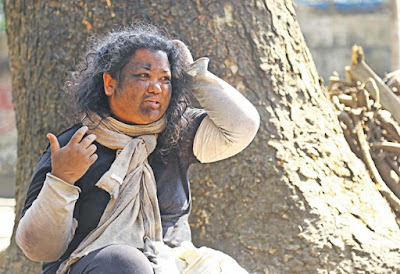
Keepa Maskey (Nepal) discusses the influence of Bhoto Jatra in her performance.
 Photo: Md. Rahat Kabir

D'LAB's theme for this year was set to “Performing Tradition and Text”, a second installation of the project since 2017. The three words describe perfectly the intent behind the event. Both texts and traditions, the latter including religious, secular, rural and folk rituals, serve as remnants of native culture in any given place. A text impacts its audience, on the one hand, by influencing their thoughts and beliefs, shaping their myths and their popular culture. But the text or the myth itself also evolves as it travels through time and space, absorbing the history, the culture, the generations of readers that it interacts with along the way. By transforming into a myth or a ritual, a text therefore becomes a part of history. To visit it in its traditional setting—watching a Jatra performance or a shaapshiri khela, for instance, or watching a farmer plow a field—is to merely witness the tradition as an audience or a bystander. But the Live Art Biennale this year sought to 'perform' such rituals through live art, meaning that the present-day realities of the participants travelled with them as they revisited the traditional rituals. The result was a contemporary rendition of native culture—open to interpretation by the audience as much as by the artists—and an exploration of what it means for such rituals to exist in the world today. 

What does it mean to hug the earth when it is covered in dust and the detritus of a dried-up pond? What does it mean to sit together for hours in an open space, free to talk or look around or even leave, and yet be compelled to stare into one's phone? Why do we still need lawnmowers when green is so sparse in the city?


Twenty-eight artists from around the USA, Asia and Europe are performing at the festival this year. While the performances on February 6 included local Bengali attractions like banornaach (monkey dance), shaapkhela (snake charming), puppet-making workshops and other traditional magic tricks, the previous days included displays that incorporated traditions and experiences brought over by foreign artists. At the bottom of the dried-up pond in Charukala, Nepalese artist Keepa Maskey began by cleaning the ground as a show of respect. Then she wrote down her thoughts on scraps of paper—an unplanned decision taken to calm herself down. She started stitching and playing with threads, and tied a piece of Nepalese textile fabric around the gathered circle of onlookers. She took sips of yogurt from a cup made of mud. She rested her head on the ground to feel and honour the soil, and rolled around on the ground and the sprinkled ashes. Finally, she rolled up the scraps of poetry and stashed them into the cup she had drunk from. The poetry was left behind for anyone to read, take home, or even burn or throw away. 

“I was trying to reflect on my culture, what I've been taught and how I was raised, and how that has influenced who I am becoming as a person and an artist,” Keepa explained to me after we climbed back up the pond. “I was trying to address how mythology doesn't really fit well with contemporary life.” She was influenced by the Bhoto Jatra Festival of Nepal, which derives from the myth of a healer farmer awaiting the arrival of a snake king to prove that he had presented him with a diamond-encrusted vest.

“The story affects me negatively when I read it now,” Keepa shared. “It contains such strong themes of class division, whereas today we try so hard to make a collective world. Based on this myth, I was trying to express how suffocated I feel with the fuss of contemporary life. I have also recently experienced an earthquake in Nepal. That kind of tragedy changes your views on life, when you struggle to breathe and access the basic things in life. All of these elements were present in my performance. There was mythology, there was Nepalese culture. How we celebrate festivals, how we pray. I also wanted to engage with the audience, and so tying them with the fabric was my way of creating a bhoto—a vest—for them. I had also wanted to become one with the Bengali soil by rolling around in it, but I found that it was rough and resistant to my rhythm. That was an interesting experience for me.” 


Open Interpretations

Mohaiminul Huq Khan, a musician and artist, who was present among the audience, was struck by how immersed Keepa and some of the artists were into their performances. “They were so into their character that they were surprised when I called the act a 'performance',” he pointed out. Finding parallels between Keepa's act and that of Indian artist Dimple Shah, who performed her interpretation of the 12th century Kannada poetry of Akka Mahadevi, Mohaimin said, “The beauty of it was that they both adopted a ceremonial/ritualistic approach. The utter intensity of the moment led me to believe that I was in in the middle of a serious, almost religious, communication between both sides of death. Keepa's performance felt like an interaction between her own psyche and an external supernatural entity.”


Meanwhile, comparing the opinions of the artists with the audience revealed how subjective interpretation of live art can get. On the fourth floor of a lecture hall in Charukala, Korean artist Johyoung Park stood atop a cloth scribbled with Korean writing, smashing multi-coloured water balloons on her head. She washed herself clean with water from a plastic bottle. She sat down, picked up the coloured water that had collected in a tin bowl beneath her feet, and drank the bowl empty. She then lay on the ground, face first, and wormed her way beneath the scribbled cloth, covering herself with it. She slowly stood back up and walked out of the room, trembling with cold, with the cloth wrapped around her.


D'LAB 2017 materials exhibited at Edge Gallery Dhanmondi. Photo: Md. Rahat Kabir


Toufiqul Huq Emon, a Drama teacher at Scholastica school and one of the audience members, took it as a commentary on the way the world imposes its weight on a person, until she has to drink it down and find the strength to rise back up while embracing it. We spoke to Johyoung about what had influenced her, and discovered a completely unexpected theme behind the performance. “My piece was titled 'Habit',” she explained. “On the cloth I had written 'How many times should one repeat an action?' I was trying to express how we tend to form habits out of repetition and traumatic events, and how that often prevents us from being open to new ideas. That's why I tried to cleanse myself with the water and internalise others' thoughts by drinking them in.” Both Mohaimin and Emon, who had joined us in the conversation, were surprised at each of our different interpretations of the act. “I guess that's art,” shrugged Mohaimin.


An Inclusive Experience

That live art can be fun as well as thought-provoking was revealed by the exercise put together by Yuzuru Maeda of Japan. Random audience members were roped into putting on a green spandex costume that covered them from head to foot—face included—and linking limbs together to form one moving organism. They had to shuffle and crawl their way through the Charukala building, down the stairs, and across the street while maintaining the huddle. Curses and directions flew out from within the knot in a handful of different languages. It was sweaty, messy, and hilarious.


Kazi Wasef Mustafa, one of the randomly selected participants, laughingly talked about how surreal it was to feel so connected to a horde of strangers. Burhan Al Rahman, another participant, shared, “The act displayed many realities of collectivism such as evolution and communication of a single unified horde that is made up of individuals, united by their lack of identity and a current predicament. It reflected a primal yet ever continuing human process of survival, exploration and existence.”

The writer can be reached at sarah.anjum.bari@gmail.com

Wednesday, December 11, 2013

The Black Fever - Live Performance in Delhi


This performance was about the darker shade of society. We are constantly bombarded with socio- political and religious issues in India. Every day we are bombarded with news of rape crime and even now when I am writing this the new rape case shown in News and might be even when I am performing some rape might be happening in any corner of our country every minute.  Every day we are left with feeling of helplessness with situation this news keep on circulating in one form or other form and we feel entangled with such unpleasant and insecure life with no hope for any good future.

Visually I wore black mourning dress with face covered with see through black mirrors that reflects audience face; simultaneously I could see audience, though audience could only see their reflection in Black. I have chosen black costume, to mourn, to show dark feeling and wound which has grown like black patch/reflection of society. I had conceived this idea keeping in mind the capital city New Delhi, since the news of Nirbhaiya, there had been no change in social security of women and especially girls and we have been seeing only an alarming amount of crime rates day by day in the villages, town and major cities in India. I really don’t understand why there is such a rise in such crimes may be  because those who  break laws and who does the crime  don’t have any more fear to be caught and punished, may be also due to decrease in moral values and respect to women or should we blame Bollywood items number and vulgar songs for this? We need to question and also seek out for answers about like what kind of mind set of people in the society is? Why women are not secure in India?  Once known for its moral and ethical values. 

The performance was done in highly populated area with migrated population from villages around and African population in Khirkee Village, Delhi and I used multiple audio receivers to interact with people in public space. The attempt was to bombard news to my audience just like News channels to a level of intolerance, to make them react and become sensitive towards issues of security and respect to women and voice their concern, rather than being passive to situations, I wanted my audience to react and become sensitive to issues rather than neglecting it as it has become a common news.


This performance was well received by people, some with very strange reaction they wanted me to pay to hear the audio and some seriously indulging in issue and inquiring whether I am activist or social worker etc., there were some more strange reaction since one audio was to calm them but they thought it was Bollywood music and tried to find out what song it was about.

Dimple B Shah
2013

Saturday, December 7, 2013

Karmic Connections I

Performance at National Gallery Of Modern Art, Bangalore.


As per Jain philosophy, I strongly believe in Karmic Connections. We come across many people in our life, good or bad, because we may have earlier connections with them.


Karmic Connections-Dimple B Shah, Performance Art In India.
This performance was about how we connect our self to others. I wanted my audience to see themselves in me, by interacting with me one to one in a time and space. 

Although my audience come from different origin, roots, environment, space and experience. During the performance we are going to experience a moment of time and space together and I  used few objects as my tool to look into the past, present and future. In this moment we are building our bonds and we will all recollect our memories of the past and will look towards the future. In this performance my audience or my fellow performer will not see my face but they will see their reflections (in multiples) on to the small mirrors tied around my face, thereby encounter me in multiple perspectives and connecting with me by seeing themselves in me. It in general understands that, what we are, we see in other people. Most of the time we don’t understand opposite person properly due to our own preconceived ideas and understanding, so sometimes we arrive at positive and sometime negative emotions, hence it might block our real understanding of the person.

In general human tendency is that most of the time we assume and sometime undermine and block our way to really connect with people, It is human nature to like and love our self all the time, visually my attempt will be to show their own multiple faces instead of mine so that they might connect with me.  In this performance I tried to make connection with my audience through object of memories and they are my personal objects which are placed in front of the audience and through that they will try to see me.

Dimple B Shah
2013
Performance, National Gallery Of Modern Art, as part of ACT (Artists Create Together), Co-curated by Lina Vincent & Seema Kohli, Photo Credit Lina Vincent, Bangalore, India.
hostgator coupon