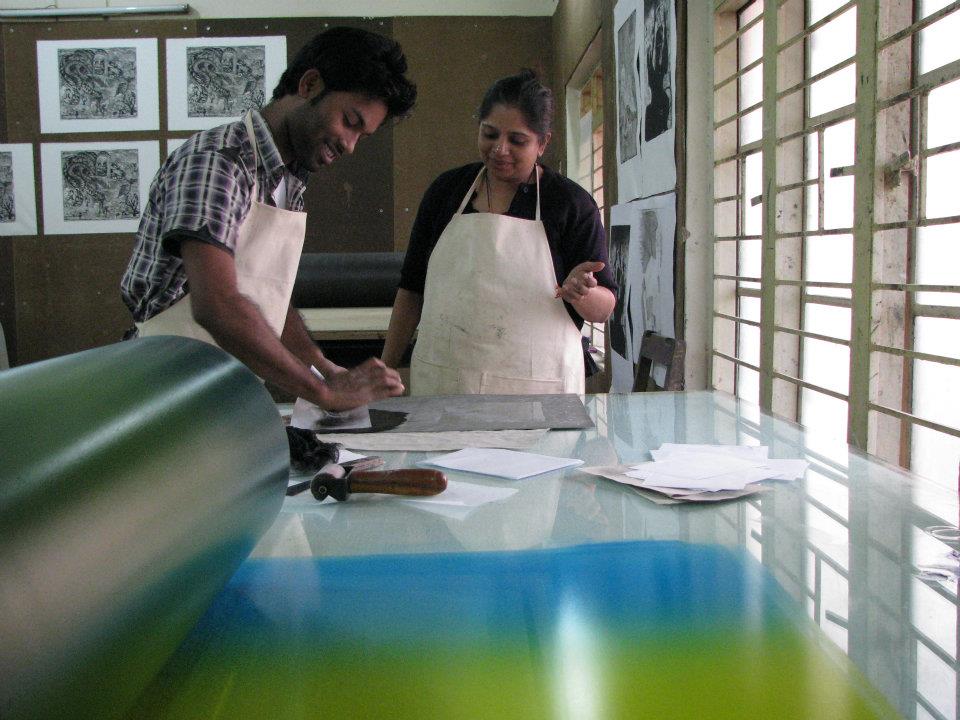
I am a multidisciplinary artist from Bangalore, studied in MS University. Currently practicing in Bangalore, Karnaraka. My work has developed in number of ways over the years yet from the very beginning of my art practice, I have workded in Painting, Printmaking, Installation, Video Art and Live/ Performance art. My intention is to blend these mediums into an interdisciplinary language.

Saturday, January 21, 2012

Milk, Melancholy & Me - Live Performance [Audio & Video] at Venkatappa Art Gallery, Bangalore, 2011


The wise man is not surprised by death
he is always ready to leave.
La Fontaine
This melancholic state is so powerful
that, according to scientists and doctors,
it can attract demons to the body,
even to such an extent
that one can get into mental confusion or get visions.
-Agrippa

Milk, Melancholy & Me, the performance was based on my experience in Mumbai during 2003. The performance was supported by video which was shot in Mumbai at Marine Drive, Chopati Beach. The video in the performance was about my conversation with the sea and myself over the period of 6 months. The  conversation with the sea starts with overwhelming feeling of its greatness and vastness, later on the feeling narrows down to a point of nothingness of self in front of it. The video narrates ones journey in metro city where he/she is isolated in there own world with no trust and faith on anybody and fear of losing self identity and dreams. It talks about struggle of individual who come with big dreams and tries to fit into this big city, searching for his/her own space and owning it. It also talks of emotive aspect like coping up with loneliness and depression which is the byproduct of mega cities. In this video I have shot very few elements like sea, waves, buildings and reflection of lights on waves. The dancing night lights and play of it on the sea bring the melancholic flavor to the video. The constant sound of waves that symbolizes the heartbeat and existence of life, the play of light in the video represents dreams that afloat. In this whole video I have continuously showed only few elements to bring in the essence of time that I have spent.

The visual treatment was the conglomeration of audio, video & my performance. In audio  I was talking about my experience in Mumbai and my journey in the city, act of drawing on canvas (like mapping my journey) and painting my face with black color. During the performance I distributed black balloons to the audience on which I had written "I Am Here", both painting my face and black balloon symbolically representing the darkness within me. I used herbal resin incense [that is used in death rituals in general] since the element of smell was also important in my performance.

The core idea of my performance was to bring in the psychological state of mind of a person, who is in deep state of depression and in melancholic mood, who is in state of isolation and has lost all its positive power to fight back (symbolic to first stage of Alchemical process – Nigredo, this is very well explained by Carl Jung and interpreted Nigredo as the moment of maximum despair, that is a prerequisite to personal development. Nigredo is "The dark night of the soul". He says "Right at the beginning you meet the dragon, the Chthonic spirit, the devil or, as the alchemists called it "The Blackness", the Nigredo and this encounter produces suffering" It brings the ego into contact with what it fears).

The performance had both existential feeling and melancholic tone. This performance act is a healing process for me and to my audience. In audio there are two people talking one is doctor who hypnotizes his patient and the other voice is mine, who is the patient and takes the journey to the past. (This conversational format was sourced from psychotherapy session and psychoanalysis and expressed here as metaphor. A doctor usually lets the patient speak and listens without judgment, later offering gentle insights and suggestions. Sporadically there occur precious & magical ‘Frozen Moments’, named so by the Jungian therapist Beverly Zabirskie, when boundaries between the patient and the doctor dissolve and in their shared warmth immobilized random traumas of childhood melt away to enable mutual healing). I concluded my performance by the act of pouring milk on my face and this ritualistic act symbolized healing. I am thankful to Smitha Cariappa to give me an opportunity to perform.

Friday, January 6, 2012

Connecting with the city - Live Art 2011, The International Festival Of Art Performance


Live Art 2011, the international festival of art performance organized by Smitha Cariappa, our adept in the field, was a special event with workshops, presentations and theory. One appreciated her idea to introduce the still new here medium to the broad audience as well as the city to the foreign participants through works by young local artists along a stretch of Mission and Double Roads spanning the artists’ initiative spaces of Bar1, Jaaga and 1Shanthi Road (November 15). Moving on, referring to, questioning and engaging with the place and people, its actual life situations, ethos and behaviour, the artists established a tenuous and fleeting, yet often vital link with the chaotically revelatory dynamism of the surroundings. 

As such, it seemed to bridge the otherwise prevalent and unfortunate gap between artists and the locale. That the performances were simple, easily readable on the surface and sometimes visually striking, indeed attracted passers by, their responses ranging from plain curiosity or literal naivety to basic recognition, policemen’s bewildered doubt included. The day started on a median with Vasudev C in protective gear cleaning it in suggestive-symbolic gestures, after which nearby school children were directed to seriously paint Mangala’s large kite, while Sapna H S as a little girl was whistling shrilly in control of the traffic, her actions later helping the occurrences’ progression. 

A high-point of sensitive presence in gravity became Deepak D L, his body painted the road divider’s camouflage black and white, evoking a fragile center of calm and stability amid the noisy haste. Another focus was Dimple B Shah who on the side of a petrol station spread her ware of cheap healing perfumes, and attired in red robes, her face a telluric green, fascinated onlookers like an ancient ritualistic performer. A very rough, raw and disturbing but also tender piece came from Sushil Kumar, a senior Delhi artist, who circled under the garbage-strewn flyover to cross the road with his head under an old, heavy commode, indeed letting the viewers sense the burden of dirt we imbibe from around. 

As the night fell by the fuming, blaring junction, Mangala wearing an oxygen mask lit by a green torchlight dared the traffic and with ordinary-dramatic gestures confronted drivers letting both them and pedestrians intuit the mutual danger and suffocation. Whilst those contributions provided culmination points, numerous other happenings kept up the interrupted continuity gracefully or with a subtle kind of obviousness addressing issues of drinking water and trash (Pallem Yamini, Monica Nanjunda), personal confusion (Navya A), the fate of urban birds (Asha Rani N) and farmers (Subramanya), spirituality (Samir Paul) and psychology (Deepak and Venkatesh K N), undermining gender roles (Sapna as a fashionable panipuri seller) or proving resistance to the melee with slow-walking on the edge Raghu Wodeyar listening to music.

Whereas Nilesh S Dubrekar displayed a painting on the ground, Vasudev and team performed a surgery on a fruit cart vendor, its strategic placement on a tyre repair shop’s isle both gathering chance spectators and stimulating artists towards spontaneous fun ventures with available objects. The evening ended with a general mock-gun-battle and constant stair washing at 1Shanthi Road by Siri Devi, after a perhaps misguided effort of contemporary dancers (Jyotsna B Rao and Abhilash Ninjappa). A messily charming frame mapping the process was created by Suresh Kumar G R who followed everything leaving behind a trail of yellow paint drips.

Marta Jakimowicz

Saturday, December 31, 2011

A wonderful Experience, National Printmaking Camp - 2011


National Printmaking Camp organized by Lalit Kala Academy, New Delhi at Indira Kala Sangeet Vishwavidyalaya, Khairagarh (Chhattisgarh) was my first National Printmaking camp that was attended by Mr. Jaikrishna Agarwal, Mr. Anandmoy Banerji, Mr. V.Nagdas, Mrs. Asma Menon, Mr. Mahesh Prajapati, Mr. Aftab Ahmed, Mr. Salil Sahani, Mr. Bijoy Velekkatte, Miss Dimple Bhupatrai Shah & Mr. Sudhakar Chippa. Being the youngest participant of the camp, it was a wonderful experience. Working with senior artists from different parts of the country and students of Indira Kala Sangeet Vishwavidyalaya, was as if I was in the middle of two generation. I was amazed with the fact that being in the remote part of central India the graphic department was well equipped with some good facilities for printmaking mediums like lithography, silkscreen and etching. I think it was helpful for both artist and the students, especially for students since they could see some different techniques from artists who were specialized in photo etching and other mediums. 

Apart from technical skills I believe it also gave students an opportunity to understand works of senior artists. During the camp participants made presentations of their journey in the art field and showed their works, I believe that would have also helped students (upcoming artist) to look art in a broader perspective. The works of students were very impressive, there command over skill & mediums was something that I noticed was good. The most interesting part of the camp was enthusiasm and curiosity among the students to learn and understand techniques which created a live environment for interactions and sharing of ideas between artist and students and the camp was filled with lot of positive energy. In the middle of this somewhere in my heart I was wondering that most of the art schools in India give good training in developing skill and draftsmanship to the students, but they lack to give theoretical knowledge that develops language of expression.

On personal level this camp gave me an opportunity to interact with artist on various issues relating to art and also about their works. It was very interesting to have a dialogue with senior artists like Mr. Jai Krishna Agarwal one of the senior most artists in the camp and discuss various issue of art. While discussing on performance art he gave a good example about a theater person Richard Schechner who traveled India with his new concept of theater to involve general audience as part of the play not dividing the line of stage and audience space but then he discovered in one of the Ram Lilia festival that the whole city was involved in this play, then he wrote a book titled-From The Ramlila To The Avant-garde (1983). One more important discussion that was interesting was with an artist who came from Jammu Kashmir, who used Arabic scripts in his works.

He used Arabic script to express his thoughts with minimal touch of calligraphy in his work. One more important artist who did engraving was Mr. Salil Sahani, who almost sculpted zinc plate. Also it was interesting to see how Mrs. Asma Menon while working on plate took full liberty of experimenting with Zinc plate. A full force of act came from Mr. Anandmoy Banerji who acted as energy booster for students while working on various mediums like Etching, Silkscreen and Lithography, showing possibilities to students on respective mediums. The best part of the camp was sharing my art work with artists, discuss various aspects of my work and get their feedback. I think for students my presentation would have been helpful since I not only shared my printmaking works but also showed them my performances, installations and I feel that would have given them an insight to know possibility of other language of expression and experimenting with different mediums. I am thankful to Lalit Kala Academy for recognizing me and providing me this opportunity.

In my opinion more such opportunities should be provided to artist from younger generation, it will be an advantage to expand their thought process and help them continue their art practice, since these kinds of camps gives moral support to an artist for being a part of art community at large.

Photographs by: Prof. Nagdas Velayudhan

Sunday, October 9, 2011

Contemporary Voices - Compiled from interviews by Waswo X. Waswo

In early August I asked a selection of younger artists to talk about their work via answering a short questionnaire. All of these artists have been, or currently are, highly involved with printmaking as a medium. The artists questioned were: B. Karuna, Dhruv Sonar, Dimple Shah, Jagadeesh T.R., Kurma Nadham, L.N. Bhuvaneshwari, Maripelly Praveen Goud, Prathap Modi, Moutushi, Neeraj Singh Khandka, Prabhakar Alok, Preeti Agrawal, Rajan Fulari, Rajesh Deb, Soghra Khurasani, and Srikanta Paul. Below are selections from their varied responses.

L.N. Bhuvaneshwari:  My imagery has often been things like motorcycles and ceiling fans. Reality can never be completely reproduced, so I grew curious about what happens to the essence of an image when it is bent and squiggled by the human hand. The cement and metal plants of a factory, the automobiles...hard iron and jagged-edged reality gained strangely soft edges when isolated from their harsh surroundings. But my fascination with machines didn't end there. In some ways they seemed essential, in others, senseless. Reality became fraught with uncertainties, paradoxes, limited joys and infinite anguish, all speeding towards an unknown direction, a symbolic representation of human progress, destructibility, creative goodness and its inherent evil. Carving, etching and printing became to me a means of seeking harmony and integration.

Maripelly Praveen Goud:  I am more fascinated with science, technology and mathematics. I use science diagrams, schematic drawings, circuits, electrical elements and other images in my prints. I started working on portraits (the black portrait series) and gradually made them more conceptual. Always my works questioned “originality”. For example, one of my prints which is titled MODERNIZATION, tells how culture and tradition is slowly vanishing in villages and technology is reaching almost everywhere. This is partially personal experience because I myself migrated from a village to the cities.

Sunday, January 2, 2011

Breaking the mould

Dimple B. Shah is an artist whose chosen medium is the canvas. But, “Art is expression, and sometimes it needs to go beyond the boundaries of two dimensions to be expressed,” she says. The young artist from Baroda adds, “Apart from painting and printmaking, I also perform live to support the concept of my video art projects.” She represents the new generation of artists, who are not afraid to experiment with new media and techniques to practice their art.


Dimple, who explores the concept of personal alchemy in her latest exhibition ‘Catharsis of Forbidden Zones’, explains one of her installations: “The catharis chamber, is a shower box which represents total purification of body and soul.” The piece includes 1,500 medicine bottles, ash, salt, nail and hair samples as well as written words.
December 31st, 2010 Deccan Chronicle

Friday, December 31, 2010

Ouch! Artist bolts camera to skull for year-long show


"It still hurts," says Wafaa Bilal. And that is perhaps not surprising.

The Iraqi artist has a camera attached to three titanium plates, bolted into the back of his skull. The camera is taking one photo every minute for the next year, and is feeding the images in real-time to a new show of contemporary art in Doha, Qatar. It also tracks his every move via GPS. All this in the name of art. But the pain is getting to him just a little. "I still have to treat it regularly with hot towels and salt water," he told BBC World Service.

Girlfriend's view
Everyday life has got a bit more complicated. Taking a shower, for example. Wafaa hopes to upgrade his camera to a water-proof one soon, but in the meantime, he needs to wear a shower-cap - transparent, of course. Or going through airport security, which on his first flight proved a lengthy process, involving various scans and tests. And what view does his girlfriend take of his unusual artistic experiment?
"So far, she is very supportive and has not imposed any lens cap curfew for any moment of our lives," he told the BBC. But it is early days. "The entire project is very dynamic," he adds, offering himself a little get out clause. Wafaa Bilal is a photography professor at New York University's Tisch School of the Arts, and that is one place where he has agreed to put the lens cap on, to protect the privacy of his students. When asked why he is doing it, he gives several reasons, but one is connected with having fled Iraq in 1991 - and having nothing to remind him of his former life.
"My city Najaf was under bombardment and the smoke was rising from it, I wished at that moment that I could record what was left behind," he says. He spent two years in a refugee camp, before moving to the US, where he was granted political asylum. Most of his family stayed behind, and in 2004 his brother Haji was killed by a missile at a checkpoint. His father - heart-broken and devastated - refused to eat or drink, and died soon after.
Surgery refused
This project ensures that he will at least have a full and permanent record of his life in 2011. But Wafaa says the project is also intended as a comment on today's surveillance society, where people in cities spend much of their lives under the watchful eyes of security cameras. He spent three years trying to get the project going, but hit several brick walls. Gallery after gallery turned him away, and doctors refused his request to have the camera inserted into his head, deeming it too risky.
In the end, he had the work done at a body-piercing studio, and had to opt for a slightly scaled-down version of his original plan, with the mounting posts inserted into his head, rather than the camera itself. His piece, called The 3rdi, is showing at the brand new Mathaf: Arab Museum of Modern Art in Doha. It's part of an exhibition of 23 new works that is the first ever contemporary art exhibition in Qatar, and "the largest to be held in the Arab world within a museum context," according to co-curator Till Fellrath. Critics descibre the project as a gimmick, say it intrudes on other people's privacy, and question whether it is really art.
Body in charge
"People react very sharply - should someone do this kind of thing and isn't it gruesome? But Wafaa Bilal is raising a lot of issues of our time," says Till Fellrath. The artist has a track-record of controversial works under his belt. Earlier this year, he had his back tattooed with a borderless map of Iraq, with a dot marking the spot of each Iraqi and US casualty. And he once spent a month confined to a gallery in Chicago for his project Domestic Tensions, where people around the world were invited to shoot him with a paintball via a webcam. As a photographer, he likes the idea of his body - instead of his eyes - being in charge of the camera shots for a change. "There are some quite strange ones, and many, many mundane images that individually may not be that appealing, but collectively they form a quite nice mosaic from everyday life."
He sees the camera as "part of him" and says his project provides a small taste of the future. As technology develops, he says, instead of carrying devices like mobile phones around with us, they will increasingly become integrated with the human body.
BBC

Tuesday, November 30, 2010

Unseen Picasso paintings found in garage

A huge cache of canvas painted by Pablo Picasso nearly 100 years ago were unveiled for the first time by a French man who claimed the art works were gifted to him by the legend. The collection of 271 paintings, drawings, sketches and lithographs, many of which were previously unknown, dates from 1900 to 1932. The extraordinary works of Picasso, worth more than 50 million pounds, were found at the home of a retired French electrician, The Guardian reported.


The revelation came on Sept 9, when Pierre Le Guennec, in his 70s, approached the office of the Picasso Administration, which manages the artist's legacy, seeking certificate of authenticity of the artifacts. In the office of Claude Picasso, 63, the late painter's son, who represents the artist's heirs and estate, he produced 175 different works that, he claimed, were by Picasso. The art works include nine cubist collages worth at least 40 million euros, a painting from his celebrated blue period, drawings and models for some of his most important works and portraits of his first wife, the Russian ballerina Olga Khokhlova.

Experts said many of the paintings had a numbering system known only to the painter. Various works are from the period between 1900 and 1932, when the young and penniless Picasso arrived in France from Barcelona to the beginning of his recognition as one of the world's greatest artists. Le Guennec also produced two notebooks containing 97 previously unseen drawings, along with 59 photographs of other pieces. The electrician said Picasso and his wife Jacqueline had given him the pieces after he installed alarm systems at the painter's various homes, including the La Californie in Cannes, the Chateau de Vauvenargues and the mill at Notre Dame de Vie in Mougins, where Picasso died in 1973.
In October, police raided Le Guennec's home and confiscated a total of 271 items. Le Guennec was taken into custody but was released without being charged with any crime. Claude Picasso told the French newspaper Liberation that the discovery came after Le Guennec sent him letters in January, March and April this year enclosing dozens of photographs of various Picasso works he said he owned, and asking for certificates of authenticity. Dismissing them as fakes because they did not appear in any catalogue or inventory of the artist's known work, Claude Picasso refused Le Guennec's requests.
"Many of these pieces weren't dated, which shows they should never have left his studio," he said. Claude Picasso said the collection has a "historic importance" as it was produced during a "crucial period; a revolutionary movement in art". - Hindustan Times
hostgator coupon